
Why a Few Drone Shots Can Transform Your Wedding Film
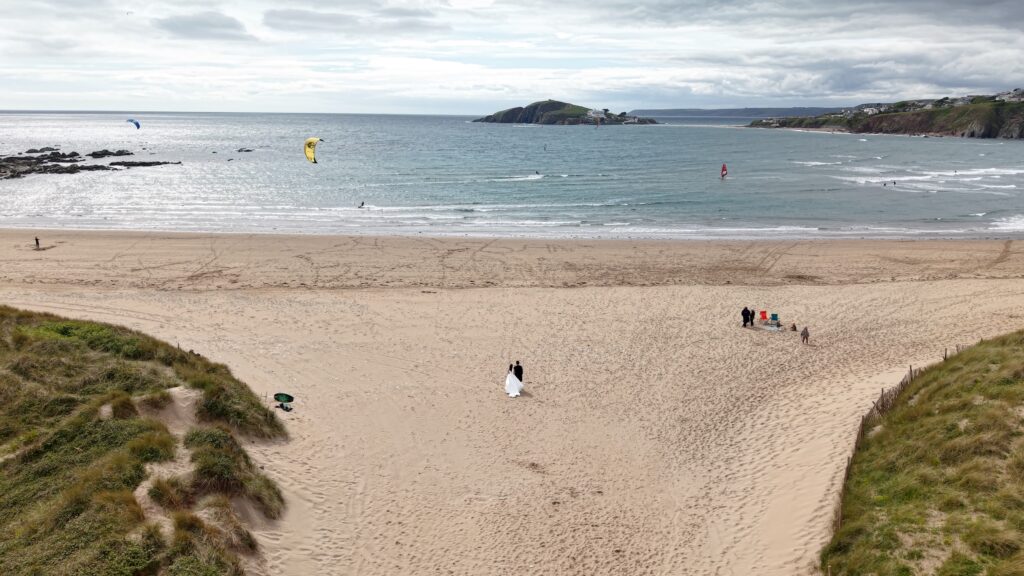
There's a moment in almost every great wedding film where the world suddenly opens up. The camera lifts, the venue appears in full, the surrounding landscape stretches out — and for just a few seconds, you see the whole picture. It's a feeling that no ground-level shot can replicate. That's what drone footage does at its best: it doesn't just show where you got married. It shows the scale of the day. And it does it in a way that stays with you long after the film has finished.
I fly the DJI Air 3S — one of the most capable compact cinema drones available — and I hold a full A2 Certificate of Competency, meaning I'm legally qualified and insured to fly professionally at your venue. But beyond the technical side, what I want to talk about here is something more important: how to actually use aerial footage well, and why less is almost always more.
The problem with too much drone footage
Drone shots have become a standard part of many wedding packages — and that's led to a common mistake: using them too much. When a film cuts to aerial footage every few minutes, the shots lose their power. The viewer stops feeling the scale and starts noticing the technique. What should be a cinematic moment becomes wallpaper.
The secret is restraint. A handful of carefully chosen aerial shots, placed at the right moments in a film, will have far more emotional impact than a reel of overhead footage that tries to show everything. I treat drone shots the way a composer treats a key change — used sparingly and at exactly the right moment, they transform the piece. Used carelessly, they just make noise.
"A drone shot used well doesn't say 'look at this technology.' It says 'look at this moment, and feel how big it is.'"
The aerial-to-ground sequence
One of the most powerful techniques in wedding filmmaking is the aerial-to-ground transition — and it's something I plan into every film that includes drone footage. The idea is simple but deeply effective: you begin wide in the sky, establishing the world of the venue, then descend smoothly into the action on the ground. The camera lands, in a sense, right alongside your guests.
Done well, this sequence does something remarkable. It gives the viewer a sense of arrival — of entering the world of your wedding rather than just watching it. It creates context. It says: this is the place, this is the setting, now here is the moment that happened inside it. It's the cinematic equivalent of a film's opening establishing shot, and it sets the emotional tone for everything that follows.
The Air 3S makes this possible with real elegance. Its camera system delivers smooth, high-quality footage that cuts seamlessly with ground-level material — no jarring shift in image quality, no sudden change in colour. When the edit moves from sky to ground, it feels like one continuous breath.
01
The arrival reveal
A slow, high ascent above the venue as guests arrive — pulling back to show the full setting, the grounds, the surrounding landscape. Perfect as an opening sequence to set the scene before the ceremony begins.
02
The aerial-to-ground descent
Starting high and gliding smoothly down toward a key moment — the couple leaving the ceremony, the first kiss, the wedding party gathered outside. Drops the viewer right into the heart of the day.
03
The location portrait
A single, held aerial shot of the venue in its environment — especially powerful at golden hour, or for venues set in dramatic countryside, coastal, or historic surroundings. Devon and Cornwall offer some of the most cinematic backdrops in the UK.
04
The send-off
As the couple departs — whether by car, on foot, or through a confetti tunnel — a gentle rising shot that follows them out and then lifts away. One of the most emotionally satisfying ways to close a wedding film.
Why qualifications matter — and why you should ask
Flying a drone commercially in the UK without the proper certification is illegal. It's also, frankly, not something you want happening at your wedding. An unqualified operator creates real risks — to guests, to the venue, and to the footage itself if things go wrong. When you book a videographer who includes drone footage, it's worth asking directly: are you A2 CofC qualified? Are you insured for commercial drone operations?
I hold the A2 Certificate of Competency (A2 CofC), issued under UK CAA regulations — the qualification required to fly commercially in close proximity to people and built-up areas. Every flight I conduct is planned, risk-assessed, and fully insured. Your guests, your venue, and your footage are in safe hands.
Beyond legality, qualification means planning. Before any wedding I check airspace restrictions, assess the venue environment, and identify the best positions and timings to get the shots I want without disrupting the day. Drone flying is invisible when it's done properly — your guests barely notice, and the footage tells the whole story.
Is drone footage right for your wedding?
Honestly, it depends on the venue and the day. Drone footage is most powerful at outdoor or semi-outdoor settings with interesting surroundings — country houses, coastal venues, gardens, converted barns, historic estates. The South West is, in that sense, one of the best places in the country to get married if you want aerial footage that genuinely takes your breath away.
For intimate indoor ceremonies in city-centre venues, drone footage may play a smaller role — or I may choose to keep the film entirely ground-based if that serves the story better. That's a decision I make with each couple individually, because the film should always be in service of the day — not the other way around.
"The best aerial shots don't feel like drone footage. They feel like the world exhaling."
If you'd like to talk through whether drone coverage is right for your venue and your vision, I'm always happy to chat. Just get in touch — and if you want to see what a well-placed aerial sequence can do for a film, I'd be glad to show you.
Richer Films · Plymouth